







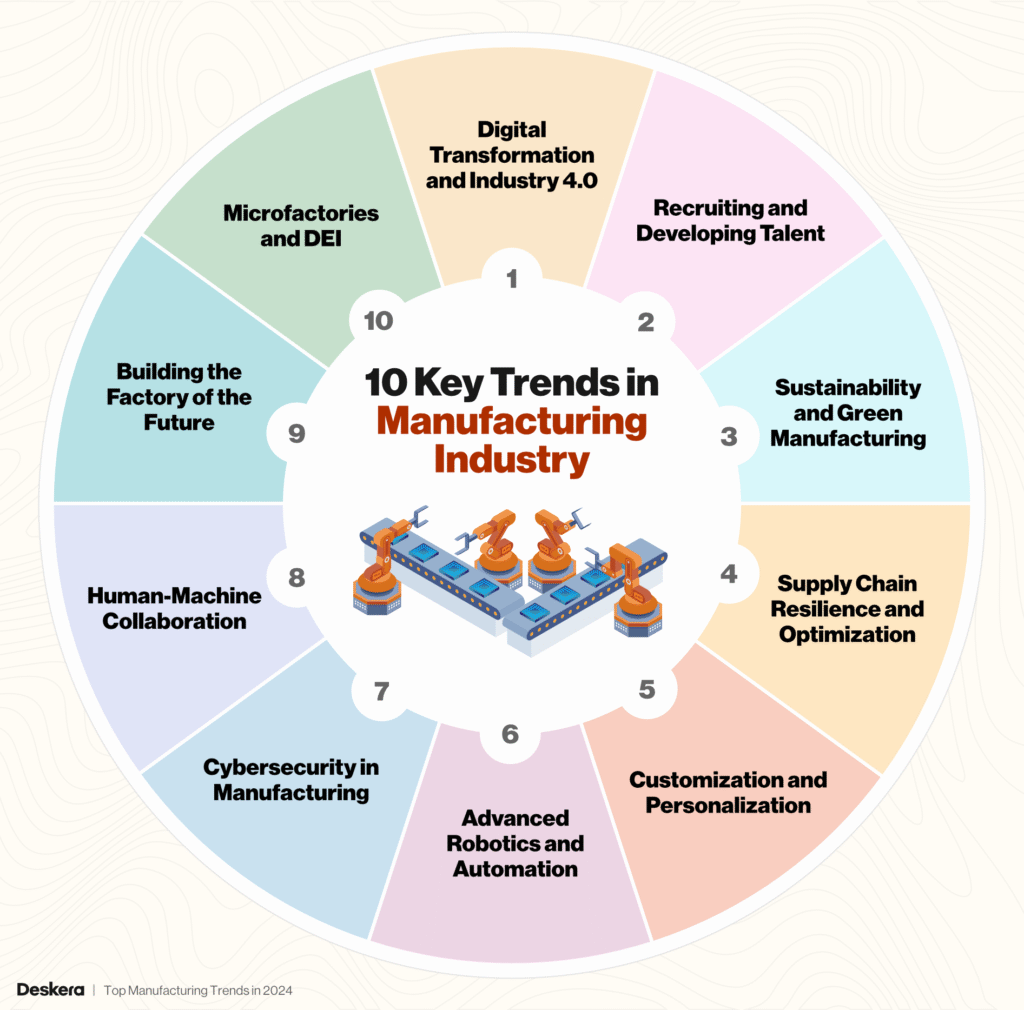
Trends in Manufacturing and Industry 4.0
The advent of Industry 4.0, known as the Fourth Industrial Revolution, has ushered in a transformative era for manufacturing and production. Unlike previous industrial revolutions—marked by mechanization, electrification, and automation—Industry 4.0 centers on the integration of cyber-physical systems, the Internet of Things (IoT), big data, artificial intelligence (AI), and advanced robotics. This convergence is not only reshaping the manufacturing landscape but also creating new opportunities and challenges across various industries. Let’s explore the major trends driving this transformation.
Smart Factories
One of the most defining features of Industry 4.0 is the rise of smart factories. These digitally connected environments allow machines, sensors, and systems to communicate through IoT, enabling real-time data sharing, analysis, and decision-making. Smart factories use AI and machine learning to streamline production, predict maintenance needs, and increase overall operational efficiency.
In these environments, data flows seamlessly between machines and systems, supporting autonomous adjustments and continuous self-optimization. For instance, if a machine detects a potential malfunction, it can either self-correct or alert technicians before the issue becomes serious. This predictive maintenance significantly reduces downtime, extends equipment lifespan, and lowers operational costs.
Smart factories also enable mass customization. Products can be tailored to individual customer preferences without sacrificing speed or efficiency. Flexible manufacturing systems allow for the quick production of small, personalized batches, reducing waste and improving customer satisfaction.
Additive Manufacturing (3D Printing)
Additive manufacturing, or 3D printing, is another key trend in Industry 4.0. Unlike traditional subtractive techniques, this method builds objects layer by layer from digital models. It allows manufacturers to create intricate designs that are impossible or too costly to produce using conventional methods.
This technology is transforming sectors such as aerospace, automotive, healthcare, and consumer goods. It facilitates rapid prototyping, accelerates product development, and reduces time-to-market. On-demand production also minimizes inventory needs and cuts down on material waste.
Another benefit of 3D printing is the ability to produce lightweight yet durable components—particularly important in aerospace and automotive industries where reducing weight can significantly enhance performance and fuel efficiency. As additive manufacturing advances, its applications in mainstream production will continue to grow.
Digital Twins
Digital twins—virtual replicas of physical assets, processes, or systems—are becoming essential tools in modern manufacturing. These digital counterparts allow businesses to simulate, monitor, and optimize operations in a virtual setting before making changes in the real world.
In complex manufacturing environments, digital twins can help test designs, fine-tune production lines, and improve overall efficiency. For instance, simulating a production line with a digital twin allows engineers to identify bottlenecks and experiment with different configurations without interrupting actual production.
They are also critical for predictive maintenance. By continuously analyzing data from the physical system and comparing it with the digital model, manufacturers can detect early signs of malfunction and act before costly failures occur.
Collaborative Robots (Cobots)
Collaborative robots, or cobots, represent a new class of robots designed to work safely alongside human workers. Unlike traditional industrial robots that operate in isolation, cobots are equipped with smart sensors and AI that enable them to adjust to human presence and dynamic environments.
Cobots are increasingly used to handle repetitive or physically demanding tasks—like packaging, assembly, or inspection—allowing human workers to focus on more strategic or creative responsibilities. This not only boosts productivity but also improves workplace satisfaction.
Thanks to lower costs and user-friendly programming, cobots are accessible even to small and medium-sized enterprises (SMEs). As they become more advanced and adaptable, their presence in diverse manufacturing settings is expected to rise.
Advanced Data Analytics and AI
Data analytics and AI lie at the core of Industry 4.0. Manufacturers now rely on big data to optimize operations, enhance decision-making, and predict outcomes. AI processes data from machines, sensors, and systems in real-time, revealing patterns, forecasting issues, and recommending actionable insights.
Predictive maintenance is one of AI’s most impactful uses. By analyzing sensor data, AI can predict equipment failures and suggest maintenance schedules, reducing downtime and repair costs. This leads to improved reliability and extended asset life.
Beyond maintenance, AI enhances supply chain management, product design, and quality control. For example, AI-driven inspection systems can detect defects on the production line instantly, ensuring that only top-quality products reach customers and minimizing waste.
Sustainability and Green Manufacturing
As environmental awareness grows, sustainability has become a central theme in manufacturing. Industry 4.0 technologies support green manufacturing by maximizing resource efficiency, minimizing waste, and reducing emissions.
Smart factories optimize energy use by aligning production with real-time power availability and demand. Additive manufacturing helps by reducing excess material, and AI algorithms optimize logistics to reduce transportation-related emissions.
Moreover, companies are exploring the use of bio-based and recyclable materials. Energy-efficient production processes are also being adopted, leading to more eco-friendly products that don’t compromise profitability.
Conclusion
Industry 4.0 is revolutionizing manufacturing by making it smarter, more efficient, and more sustainable. Technologies like smart factories, digital twins, AI, cobots, and 3D printing are driving a new era of innovation and flexibility. As the industrial landscape continues to evolve, companies must embrace these changes to remain competitive. Those that adapt and leverage these technologies will be best positioned to lead in the future of global manufacturing.