

Understanding Pakistan New Tax Policies in 2026
- September 18, 2026
- 0
The year 2026 has brought changes to how Pakistanis pay taxes. If you are a person who gets a salary a shopkeeper or a farmer, the new Pakistan


9621 Agnes Crossing, Lake Suzanneview, New Mexico Island 84604-9295.
The year 2026 has brought changes to how Pakistanis pay taxes. If you are a person who gets a salary a shopkeeper or a farmer, the new Pakistan
The year 2026 has brought changes to how Pakistanis pay taxes. If you are a person who gets a salary a shopkeeper or a farmer, the new Pakistan Tax Policies will affect your monthly budget. These policies want to make more people pay taxes to reduce the number of people who do not have to pay taxes and make the Federal Board of Revenue use computers. For people, it is important to understand these changes so that they do not have to pay penalties and can plan their household money.
This article will explain the points of the new Pakistan Tax Policies, who will benefit who will pay more and how they are connected to the bigger Pakistan Economic Reforms. We will also see how the IMF Loan Pakistan program made the government introduce these changes. By the end, you will know what to expect when you file your taxes this year.
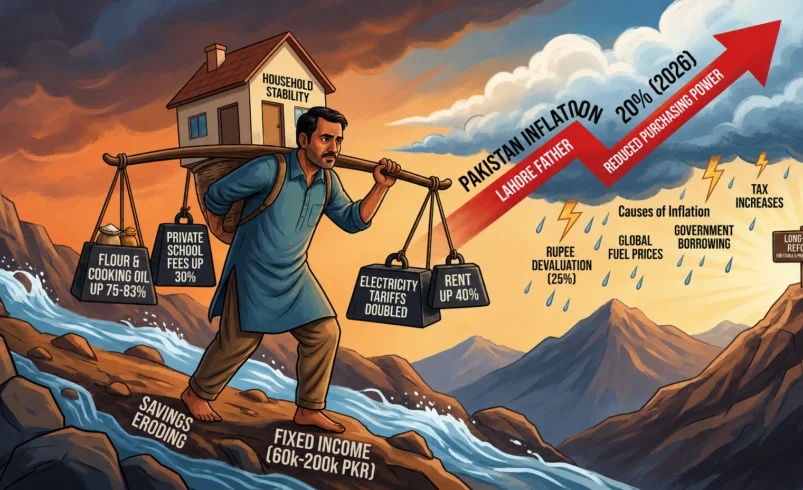
Pakistan has always had one of the tax-to-GDP ratios in the world. Below is 10%. This means the government does not collect money to pay for schools, hospitals, roads or even debt interest. The government must borrow money, which makes inflation worse. The new Pakistan Tax Policies are designed to increase the tax-to-GDP ratio to 13% by 2028. They focus on three groups that have escaped taxation: retailers, and large agricultural landowners. The changes are also a condition of the IMF Loan Pakistan program, which requires the government to reduce its debt.
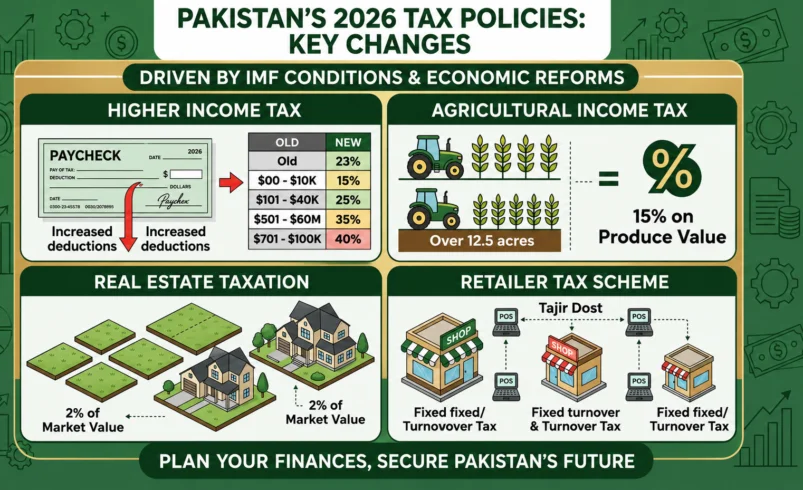
The tax threshold for salaried individuals has been lowered from PKR 600,000 per year to PKR 500,000. This means more people will pay income taxes. The tax rates have also been changed:
| Annual Income (PKR) | Old Tax Rate (2025) | New Tax Rate (2026) |
| Up to 500,000 | 0% | 0% |
| 500,001 – 800,000 | 5% | 7% |
| 800,001 – 1,200,000 | 10% | 12% |
| 1,200,001 – 2,000,000 | 15% | 18% |
| Above 2,000,000 | 25% | 30% |
For the time, agricultural income from landholdings above 12.5 acres is being taxed at a rate of 15% on the value of produce. This change is one of the debated parts of the new Pakistan Tax Policies. The government expects to collect PKR 150 billion from large farmers. Small farmers (below 12.5 acres) do not have to pay tax.
The new policies introduce income tax on property owners. If you own two residential plots or a house above 5,000 sq. Ft., you will pay 2% of the property’s market value as tax every year regardless of whether you earn rent. Additionally, capital gains tax on property sold over three years has increased from 10% to 15%.
All retailers with a shop size above 500 sq. Ft. Must register under the Tajir Dost Scheme. Integrate point-of-sale systems with the Federal Board of Revenue. Those with turnover below PKR 10 million can opt for a fixed tax (PKR 3,000–10,000 per month). Larger retailers pay a percentage of turnover (1.5% for wholesalers, 3% for retailers). If you do not register, you will have to pay a penalty of PKR 50,000. Your shop may be closed.
| Sector | 2025 Collection (PKR billion) | 2026 Target (PKR billion) |
| Salaried | 850 | 1,050
|
| Agriculture | 0 | 150 |
| Local Estate | 80 | 230 |
| Retailers | 120 | 300 |
| Others | 600 | 670 |
| Total | 1,650 | 2,400 |
The IMF Loan Pakistan program, approved in 2025 for 7 billion requires Pakistan to show discipline. Every quarter a review checks if tax revenue targets are being met. The new Pakistan Tax Policies are a response to IMF conditions. Without these policies the part of the IMF Loan Pakistan (worth 1.2 billion) would be delayed, risking a balance-of-payments crisis. In terms of this, the loan forces the government to tax more, and citizens feel the pinch.
Based on FBR data and independent surveys here are five key observations about how the new Pakistan Tax Policies are being received.
Because salaries are reported electronically, tax deductions from paychecks have increased immediately. In the quarter of 2026 income tax collections from salaried individuals rose 24% compared to the same period in 2025. Many employees report a drop in take-home pay.
18% of target retailers have installed FBR-integrated POS systems. The rest are. Delaying or using offline methods. In response, the government has started surprising inspections in markets in Karachi, Lahore, and Faisalabad. Over 2,000 fines have been issued.
Landowner associations in Punjab and Sindh have filed petitions in the Lahore High Court and Sindh High Court arguing that taxing income is a provincial subject under the Constitution. The government argues that a federal surcharge is allowed. The outcome is pending.
The newly deemed income tax and higher capital gains tax have cooled the property market. In the three months of 2026 property registrations in major cities dropped 22% compared to late 2025. Some investors are moving money into gold or dollars instead.
To avoid the fixed tax under the Tajir Dost Scheme, some small shopkeepers have reduced their declared turnover or split shops into smaller units (below 500 sq. Ft.). This defeats the purpose of the reform. The FBR is now considering an amnesty for registration.
| Group | Impact | Reason |
| Salaried employees (middle income) | Loser Lower threshold | + higher slab rates |
| Large farmers (>12.5 acres) | Loser New 15% tax on produce value | |
| Small farmers Neutral | Exempt | |
| Property owners (multiple plots) | Loser | Deemed income tax. Higher CGT |
| First-time home buyers (small house) | Winner Exemption for owner-occupied <1,000 sq. Ft. | Fines and closure |
The connection between the new tax policies and the IMF Loan Pakistan cannot be overstated. Under the 2025–2028 Extended Fund Facility Pakistan committed to raising its tax-to-GDP ratio by 1.5 percentage points each year. The IMF Loan Pakistan includes benchmarks such as “enact legislation to tax agricultural income above a threshold” and “operationalize nationwide POS integration for retailers.” If these benchmarks are missed, the IMF can pause disbursements. Therefore, every time you pay a tax or see a new FBR notice remember that the IMF Loan Pakistan is the invisible hand pushing these changes. The loan is not about foreign exchange – it is, about reshaping Pakistan’s entire tax culture.
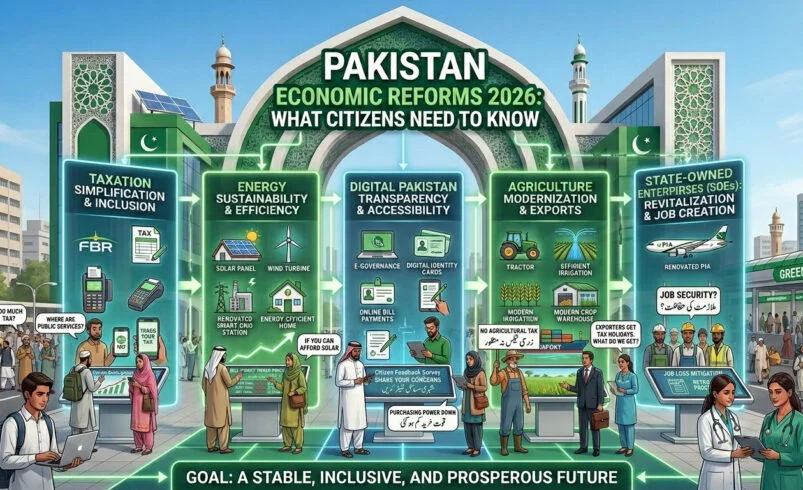
These reforms are not about taxes, they are also about making energy cheaper, selling government companies, and using computers to make government work better. The new tax rules in Pakistan are a part of these reforms. They want to make sure the government has money reduce inflation and get people from other countries to invest in Pakistan. For example, when people pay taxes, the government does not have to borrow as much money from the bank. This helps to keep prices from going up high. Also, if Pakistan collects taxes, it can use that money to build new schools and roads instead of just paying interest on loans.
The government needs to make some changes to the tax rules. It should give people time to register, and it should help small store owners by giving them cheap equipment to use. The government should also make the tax on farms go up slowly, so farmers have time to get used to it. It should help people who get a salary by giving them more money or helping them with fuel costs. The government needs to tell everyone about these rules in a way that is easy to understand.
The new tax rules in Pakistan is a change. They might be hard for some people. They are necessary. The old way was not. It was causing a lot of problems. These new rules will help make things fairer. They will help Pakistan have more money to spend on important things, like schools and hospitals. Pakistan Economic Reforms are what will help Pakistan become a place.
To sum it up the new Pakistan Tax Policies are asking people to make some sacrifices, but they also give us a chance to stop owing money and having prices go up all the time. If people understand the rules and follow them, they will not have to pay money and they will help, make Pakistan a better place for their kids. For these policies to work, the government must be honest about what they are doing and people must work together. If the government uses the money they get to make schools, hospitals, and roads better, people will trust them more. If they waste money, people will not want to cooperate. Now every person who pays taxes is helping to decide what Pakistan’s economy will be like, in the future. It is a choice but the result. A Pakistan that is prosperous and fair. It is worth it.