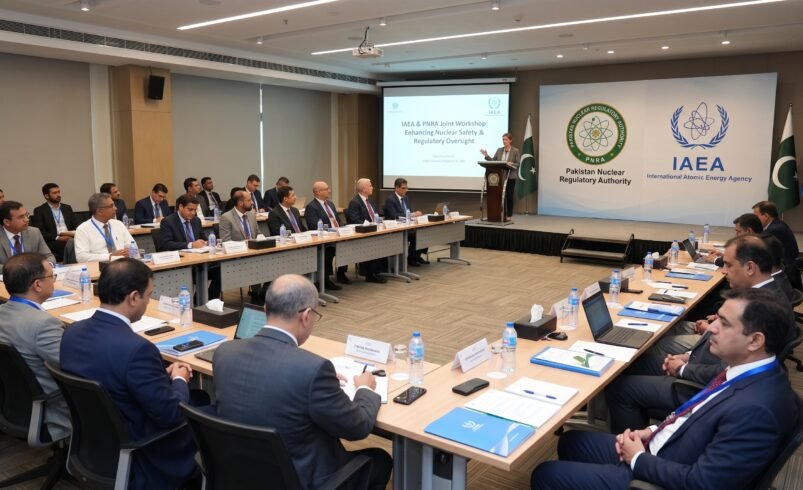
The PNRA and IAEA nuclear safety workshop has concluded in Islamabad after five days of
training and knowledge sharing. The Pakistan Nuclear Regulatory Authority (PNRA) and the
International Atomic Energy Agency (IAEA) organized the event from October 5 to 9, 2026, to
strengthen knowledge about equipment used in nuclear facilities.
The National Institute of Safety and Security (NISAS) organized the workshop as an IAEA
Collaboration Centre for nuclear safety and radiation protection. It brought together regulatory
officials, nuclear facility operators and professionals involved in supplying equipment for nuclear
installations. The participants learned about international practices for checking equipment used
in important safety-related applications. Effective safety arrangements depend on trained
professionals and responsible security officers who help protect important institutions.
The main topic was Commercial Grade Item Dedication (CGD), a process that helps experts
check whether commercially available equipment is suitable for nuclear safety applications.
Experts examine important safety features through inspections, testing and technical analysis to
confirm that equipment can perform its intended function safely. This process is especially
useful when specialized nuclear equipment is difficult to obtain.
During the workshop, Shahid Rashid, Member (Executive) of PNRA, highlighted the importance
of reliable equipment in nuclear facilities. He explained that new technologies and outdated
equipment can create challenges when organizations need specialized components. Changes
in global supply chains can also affect the availability of important parts required for nuclear
installations.
Four international experts shared their experience and knowledge during the five-day event.
They included Man Liu from the IAEA and Pekka Tapani Pyy from Finland. Kwang Young Sohn
and Yun Goo Kim from South Korea also participated in the workshop. Their contributions
helped participants understand international practices for equipment verification and nuclear
supply-chain management.
The workshop helped strengthen Pakistan’s skills in nuclear safety and equipment supervision.
It also encouraged cooperation between local professionals and international experts. Such
training can help organizations make better decisions when selecting equipment for nuclear
facilities and checking whether it meets the required safety standards.
The partnership between PNRA and the IAEA highlights the value of international cooperation in
nuclear safety. Continued training and knowledge sharing can help professionals follow
established safety practices and improve equipment reliability. These efforts support the safe
operation of nuclear installations and help strengthen Pakistan’s nuclear safety system.
Source: Media Research