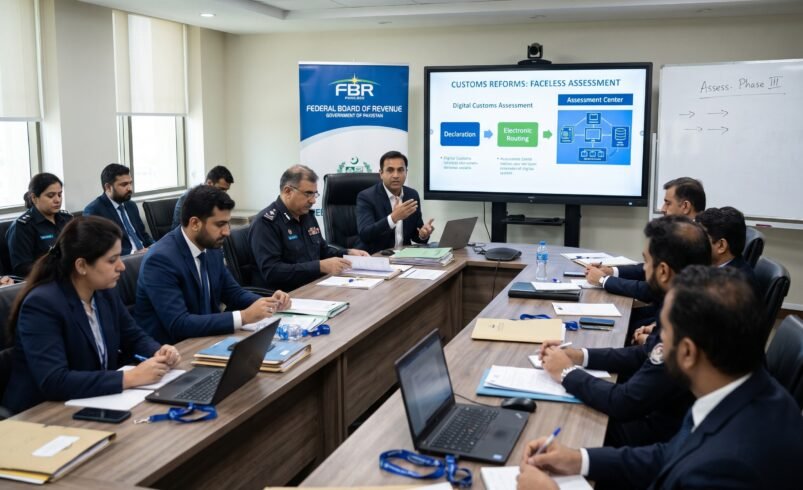
The Federal Board of Revenue (FBR) has confirmed that its Faceless Customs Assessment
system will continue as part of Pakistan’s customs modernisation programme. The board said
moving the Central Appraising Unit (CAU) to Islamabad is an important step towards improving
customs operations. It also clarified that the decision will not be reversed.
According to an official press release issued on Thursday the reform aims to make customs
assessments more transparent and efficient. The system is designed to reduce unnecessary
personal contact between traders and tax officials. It will also limit the use of personal authority
in customs decisions and promote a fair digital process.
FBR explained that only the assessment function of the Central Appraising Unit will move to
Islamabad. Other customs activities will continue under their existing collectorates. Physical
inspections of goods and port operations will remain in Karachi. Traders can also contact their
respective Karachi collectorates to resolve operational problems.
The board responded to concerns raised by the All Pakistan Textile Mills Association (APTMA).
The association had highlighted issues related to clearance delays and valuation disputes. It
also raised concerns about laboratory referrals. FBR said the figures mentioned in the
complaints mainly covered the early months of the new system.
According to FBR the average customs clearance time has decreased from 40.2 hours to 20.57
hours. The board also reported that 83 percent of consignments are now cleared within 48
hours. These improvements show progress in the digital customs assessment process.
FBR also clarified that customs valuation will continue under Section 25 of the Customs Act
1969. The digital system does not allow officers to increase declared goods values without
proper reasons. Officials must follow the legal valuation methods and explain their decisions
wherever required.
The board believes electronic documents and digital communication will improve the quality of
customs assessments. These measures are also expected to reduce unnecessary personal
contact between traders and officials. The main purpose is to ensure that customs decisions
follow laws and official procedures.
The reform is part of FBR’s wider digital transformation programme. Other initiatives include the
Digital Invoicing System and AI-based Digital Production Monitoring. These systems are
designed to improve business records and monitor industrial production. They can also help
identify tax evasion and hidden economic activities.
FBR has also announced additional steps to improve the clearance process. These include
special arrangements to clear pending export-related consignments and provide faster services
to compliant importers. The board also plans to offer green-channel facilities to Authorised
Economic Operators and eligible businesses.
The proposed service timelines include 24 hours for assessment and first review. The second
review is expected to take 48 hours. Physical examination after goods arrive will have a
proposed timeline of 24 hours. Laboratory results are expected within 72 hours with automatic
escalation arrangements for delays.
FBR also plans to facilitate provisional release of goods under Section 81 of the Customs Act
1969 wherever legally permitted. This step could help traders avoid unnecessary delays during
the clearance process.
The board has advised trade organisations to encourage their members to submit Goods
Declarations before ships arrive. Early submission can help customs officials assess shipments
in advance. This may reduce waiting time at ports and prevent additional demurrage charges.
FBR has invited APTMA and other trade organisations to share specific complaints with
supporting evidence. Traders have been asked to provide relevant Goods Declaration numbers
for reported delays and valuation disputes. This will help officials investigate problems and take
appropriate action.
FBR has reaffirmed that it will address genuine operational problems while continuing the
Faceless Customs Assessment reform. The board aims to create a transparent and
technology-based customs system that supports businesses and improves trade activities
across Pakistan.
Source: Federal Board of Revenue (FBR), as stated in its official press release.